Why More Schools Are Choosing VR Over Traditional Textbooks

Software Consultant empowering teams to deliver excellence


Why More Schools Are Choosing VR Over Traditional Textbooks
They Said the Future Was Digital—Now It’s 3D
At first, people laughed when schools started handing out VR headsets instead of textbooks. “Kids need books, not goggles,” they said. But now? The results are speaking for themselves.
In classrooms across the world, something extraordinary is happening. Students aren’t just reading about volcanoes—they’re walking inside them. They’re not flipping pages on photosynthesis—they’re watching it happen in real time.
Welcome to the classroom of today, powered by Virtual Reality.
What Textbooks Can’t Do (And What VR Can)
Let’s be honest—textbooks haven’t changed much in 100 years. Same pages. Same print. Same format. Sure, they contain knowledge. But they don’t create experience.
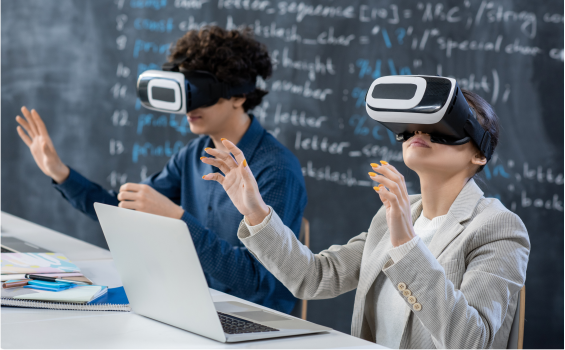
Here’s what a textbook can’t do:
- Let a student walk on the moon
- Help them build molecules in mid-air
- Show history unfolding right before their eyes
- Virtual Reality does all of that—and more. And that’s why schools are making the switch.
The Power of Presence: Why Students Learn Faster in VR
You can read about the Great Wall of China. Or you can stand on it. That’s the difference VR makes. When students experience what they’re learning, their brains lock it in. They don’t just remember facts—they understand them. That’s called embodied learning, and studies show it boosts retention by up to 75%. Imagine struggling with geometry… until you start manipulating shapes in 3D. Or trying to understand the human heart… until you explore it from the inside. That’s not science fiction. It’s happening now.
The Feedback Schools Are Giving: “Our Students Are More Engaged Than Ever”
Teachers who once fought to keep students focused are now hearing:
“Can we stay a little longer?”
VR turns passive learning into active curiosity. It’s a game-changer, especially for:
- Visual learners
- Students with learning differences
- Kids who normally struggle with focus
Because when learning feels like discovery, everything changes.
It’s Not Just Cool—It’s Practical
You might think VR sounds expensive, but here’s the truth:
A full textbook set for one subject: $300–$500
VR headset (reusable across subjects and years): $250
Lifetime of free or low-cost educational simulations: Priceless.
Schools investing in VR find it pays for itself—fast. No reprinting. No shipping. Just updates and new content as fast as the tech evolves.
What Subjects Are Using VR in 2025?
It’s no longer just a science or tech tool. VR is now used in:
- 🧪 Science – Virtual labs, chemical experiments, biology simulations
- 🌍 Geography – Explore continents, climates, and ecosystems
- 🏛 History – Time-travel tours through ancient civilizations
- 🗣 Languages – Real-world conversation simulations with avatars
- 🧠 Life Skills – Career exploration, mental health simulations, and more
VR turns abstract concepts into real experiences—and that’s priceless in education.
But What About the Critics?
Some say, “Kids need real books.” And they’re right—books still have their place. But here’s what those critics often miss: This isn’t about replacing books. It’s about enhancing learning. Giving students more ways to understand, not fewer. In the same way calculators didn’t destroy math, VR won’t destroy reading. It’ll just give students new dimensions of knowledge.
The Real Reason Schools Are Moving to VR: Results
Schools that adopted VR early are seeing:
- Higher test scores
- Improved attendance
- Better retention
- More excitement around learning
One principal said:
“When students want to show up for class, we’ve already won.” This isn’t just tech for the sake of tech. It’s working—and it’s spreading fast.
What’s Holding Some Schools Back?
Change is hard. Budgets are tight. Teachers need training. We get it.
But here’s the good news:
- More grants are available for VR in education than ever before.
- Many VR tools now come with guided lesson plans.
- Training sessions are simple, and most educators learn within hours.
In short: The barriers are falling. Fast.
Is This the End of Traditional Textbooks?
No. But it’s the beginning of something better. Textbooks will stick around—for now. But more and more, they’ll become support tools, not center stage. As VR content becomes cheaper, faster, and more accessible, it will become the first choice for many educators. And students won’t miss the paper cuts.
Final Word: The Classroom Just Leveled Up
A decade ago, “VR in schools” sounded like a sci-fi fantasy. Today, it’s becoming the standard. When you see a child walk through an ancient city, witness a solar eclipse from space, or practice surgery before they even graduate high school—ask yourself: Isn’t that better than just reading about it?
Let's Build Digital Excellence Together
Read more Guides
Agile Manifesto Misreads: Realigning with the Four Core Values
The Agile Manifesto remains the touchstone of modern product delivery, but only when teams actively translate its spirit into daily behaviours. By recognising and correcting these four misreads you reclaim the true intent of agility

Comprehensive Guide to Choosing a Node.js Development Company
Choosing the right Node.js development company can make or break the success of your software project. Node.js has become a go-to technology for building scalable web apps, real-time systems, and robust APIs. But with countless vendors and Node.js development services available, how do you identify the ideal partner for your startup or enterprise needs?
They Said Green Buildings Were Expensive—Until This Technology Proved Them Wrong
Discover how digital twins are transforming sustainable construction by helping real estate developers design, build, and operate greener buildings with higher ROI.